RFP response automation uses AI and software to handle the workflow of responding to requests for proposals: ingesting buyer documents, extracting questions, retrieving approved source material, drafting cited answers, routing uncertain items to subject matter experts, managing review, and producing the final submission. The existing draft cites Loopio's 2024 RFP Trends & Benchmarks Report for the baseline that teams spend 30+ hours writing a single bid, which is why first-draft automation is such a high-leverage proposal workflow improvement.
Why manual RFP response slows proposal teams
30+ hours per bid
The draft cites Loopio's 2024 benchmark for average bid-writing time. Search, formatting, and manual routing turn proposal teams into the bottleneck when RFP volume rises.
Answers drift across sources
Approved content is scattered across shared drives, Slack threads, old proposals, CRM records, wikis, and documentation systems. Static Q&A libraries become stale, duplicated, and hard to trust.
SMEs get pulled into repeat work
Engineers, compliance officers, and product managers get interrupted by questions that already have documented answers. The workflow should route only low-confidence, novel, legal, or technical exceptions to the right expert.
How Tribble automates an RFP response
-
Connect live knowledge
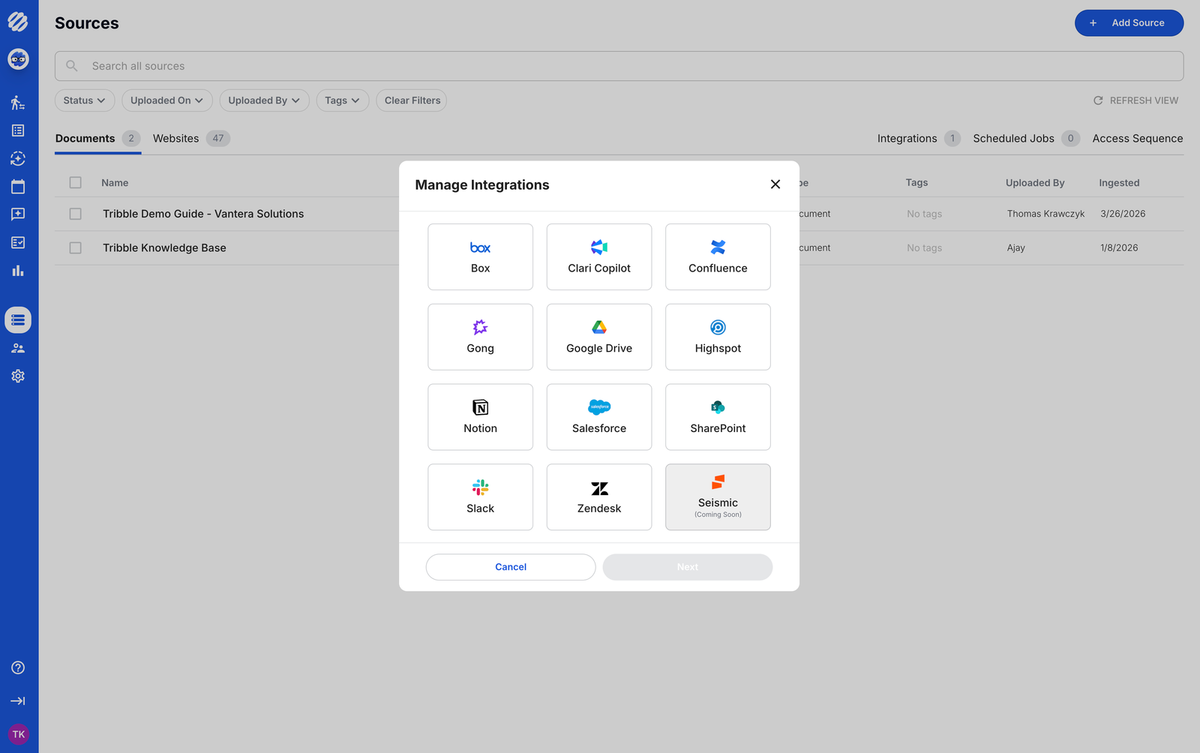
Connect the systems where approved answers already live: CRM, Confluence, SharePoint, Google Drive, proposal libraries, documentation systems, and call transcripts.
-
Ingest the RFP
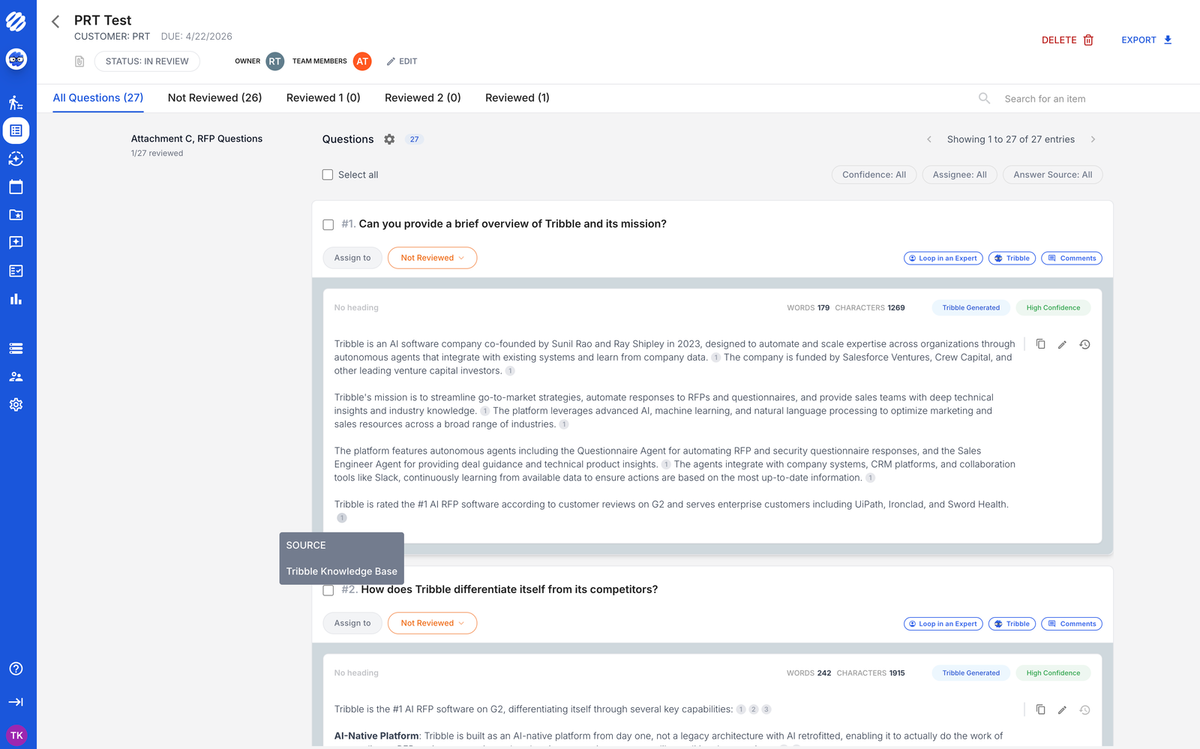
Upload the buyer document in Word, PDF, Excel, questionnaire, or portal format. Tribble parses the file, extracts every question, and identifies requirements before drafting starts.
-
Generate cited first drafts
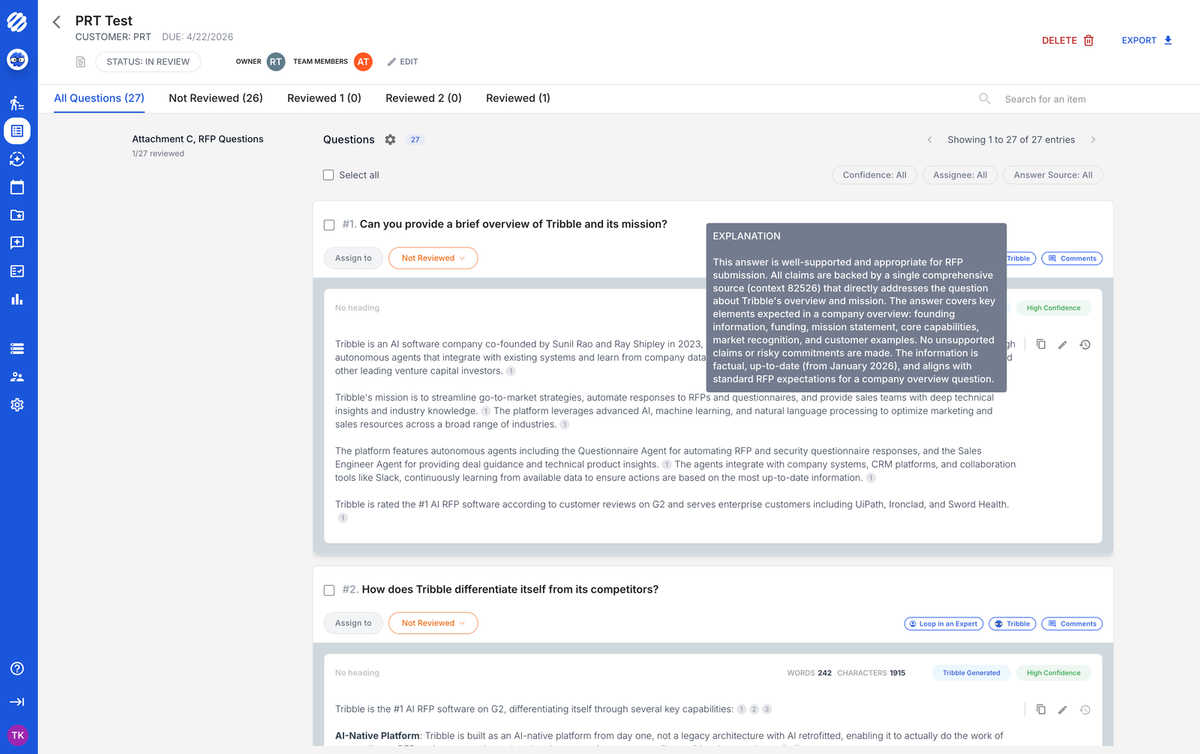
Tribble retrieves relevant approved content and drafts answers grounded in source material, with source attribution visible to proposal managers, sales engineers, security reviewers, and legal approvers.
-
Score confidence and route gaps
Each answer gets a confidence score. Answers below the draft’s 75 to 85% review threshold are routed to the appropriate SME through Slack or Microsoft Teams instead of being guessed or buried.
-
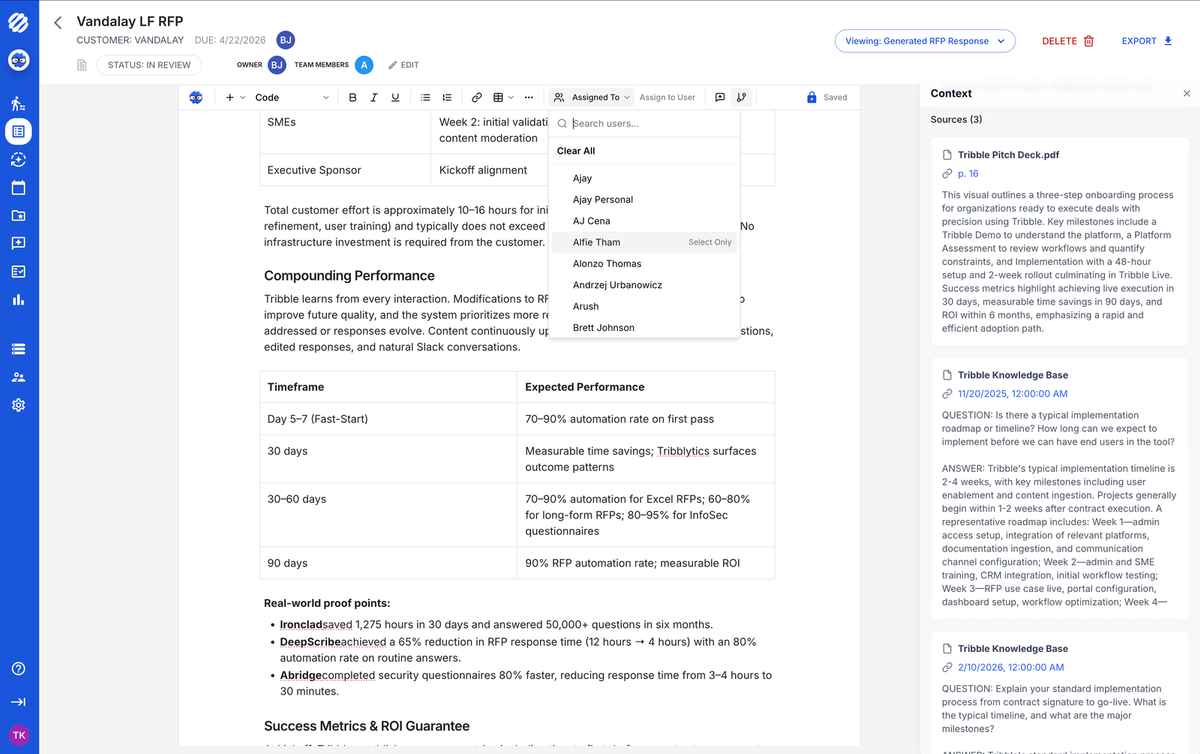
Review and approve in workflow
Proposal managers, team leads, compliance reviewers, and other approvers review the answer set, enforce approval gates, and lock approved content before export.
-
Export and learn from outcomes
Export the final response in the buyer’s required format with an audit trail. Tribblytics connects response content to deal outcomes so future drafts can improve from won and lost proposals.
How the categories compare
The draft separates the market into AI-first automation and library-assisted search. The architecture choice determines automation ceiling, maintenance burden, and how much human review stays focused on judgment instead of retrieval.
| Category | Tools | Best fit |
|---|---|---|
| AI-native RFP automation | Tribble | Generates cited drafts from live-connected knowledge sources, scores confidence, routes exceptions to SMEs, manages review, and feeds outcome learning back into future responses. |
| Library-based response management | Loopio, Responsive | Stores manually curated Q&A pairs and uses search to match incoming questions to existing answers. Familiar and controlled, but bounded by library completeness, search quality, and ongoing content maintenance. |
| Compliance and posture systems | Vanta, Drata | Helps collect audit evidence and monitor controls. Useful for approved security and privacy language, but not a replacement for drafting buyer-ready RFP, security, and privacy responses. |
| Workflow and procurement tools | Jaggaer and process tools | Manages workflow and approvals more than source-grounded first-draft generation. Best fit when process control is the primary problem, not answer creation. |
What teams get out of it
of a 200-question RFP completed in under an hour in approved Clari RFP automation proof
manual bid-writing benchmark per RFP cited in the draft from Loopio's 2024 RFP Trends & Benchmarks Report
first-draft automation range for AI-first RFP platforms using retrieval-augmented generation, per the existing draft
on G2 across 143 reviews and 19 Spring 2026 badges in the approved G2 aggregate proof
Same BrainMetrics reflect approved Clari RFP automation proof, Tribble’s G2 aggregate proof, and benchmarks already cited in this draft; results vary by source quality, RFP format, and review workflow.
The same approved security, privacy, product, and compliance sources that answer an RFP can also answer security questionnaires without duplicating response work.
Read security questionnaire automation → Unified responseThe draft frames RFPs, DDQs, and security questionnaires as connected workflows. A governed source layer keeps each buyer response consistent and reviewable.
Read the unified workflow →Frequently asked questions
Connect approved sources, parse the RFP, extract every question, generate cited first drafts, route answers below a 75 to 85% confidence threshold to SMEs, review in workflow, and export the final response. Tribble, Loopio, and Responsive support parts of the workflow, but the draft positions AI-native systems around higher automation from live knowledge sources.
AI-first RFP automation uses retrieval-augmented generation to connect to live knowledge sources and generate contextual answers for each question. Traditional RFP software stores manually curated Q&A libraries and uses search to suggest matches that humans select and edit. The practical difference is automation ceiling, maintenance burden, and whether the system improves from new source material and outcomes.
Accuracy depends on the quality of connected knowledge sources and retrieval architecture. The draft describes source-grounded drafts, source attribution, confidence scoring, and SME routing as the controls that make AI-generated responses reviewable. Novel requirements, custom scenarios, legal questions, and low-confidence answers still need human review.
Yes. The draft says questionnaire-format RFPs such as Excel and structured Q&A tend to automate most cleanly, while AI-first platforms can also handle Word documents and narrative responses by retrieving relevant content blocks, case studies, and positioning statements from connected sources.
The draft says initial setup can happen quickly, with full deployment in approximately two weeks. The main work is connecting knowledge sources such as proposal libraries, CRM, and documentation systems, then configuring review workflows rather than installing software.
No. The draft frames automation as a shift from information retrieval and content assembly toward quality assurance, strategic positioning, buyer-specific tailoring, and competitive differentiation. Humans still provide the judgment and narrative that distinguish a winning proposal.
The draft describes Loopio and Responsive as library-based platforms that store manually curated Q&A pairs and use search to match incoming questions. Tribble is described as AI-first, using retrieval-augmented generation to query live-connected sources, score confidence, route exceptions, and track outcome intelligence.
The draft covers Excel questionnaires, Word documents, PDF forms, and procurement portal submissions across security and compliance, product capabilities, integrations, pricing, company background, references, and technical architecture. Well-documented topics automate best; novel or custom questions route to human experts.
RFP response automation in 2026 comes down to architecture: does the platform generate answers from live, approved source material, or does it search a library someone has to maintain? The answer determines your automation rate, review burden, maintenance work, and how confidently your team can submit buyer-ready responses.
Automate RFP responses with cited drafts
Live-connected knowledge. Confidence-scored review. SME routing across RFPs, DDQs, and security questionnaires.
★★★★★ Rated 4.8/5 on G2 · Used by leading B2B teams across healthcare, fintech, and cybersecurity.